The Forgotten Genius Behind a Curious Number: Kaprekar and His Constants

Updated: Feb 10
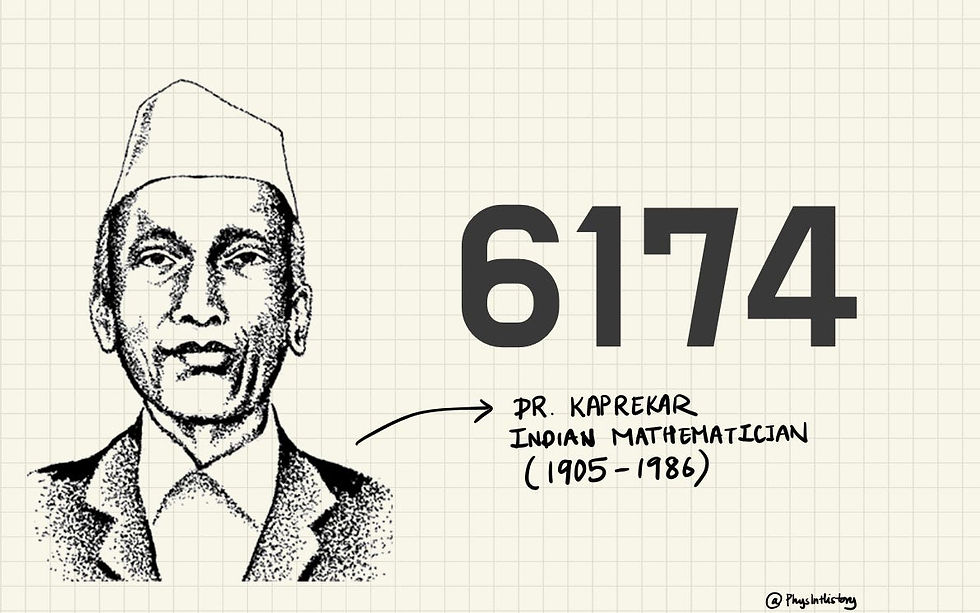
When we speak of mathematics, a few legendary names dominate global memory - Euclid, Archimedes, Isaac Newton and Carl Friedrich Gauss. From India's ancient intellectual tradition, scholars like Aryabhata, Brahmagupta, and Bhaskara II continue to be celebrated for their foundational contributions. In modern times, Srinivasa Ramanujan has earned worldwide recognition for his intuitive brilliance. Yet, beyond these towering figures lies a lesser-known but equally fascinating name from modern India- D.R.Kaprekar. Working far from academic limelight, Kaprekar discovered striking numerical patterns that revealed hidden order in seemingly ordinary numbers. Among these discoveries are two remarkable fixed points now known as the Kaprekar constants.
D.R.Kaprekar and the Birth of a Mathematical Curiosity
Born in 1905 in Maharashtra, Dattatreya Ramchandra Kaprekar spent most of his life as a schoolteacher. He was deeply interested in recreational mathematics and number properties, often publishing his works in small journals that initially received little attention. Kaprekar's approach was experimental and intuitive rather than formal, yet his observations were precise and profound.
While exploring digital rearrangements, Kaprekar discovered that for three-digit numbers (with at least two distinct digits), a simple process of rearranging digits into the largest and smallest possible numbers and subtracting them repeatedly always leads to 495. A few years later, in 1949- he extended this idea to four-digit numbers, where the same iterative process consistently converges to 6174. These numbers- 495 and 6174- became famous as Kaprekar constants, showcasing an unexpected certainty hidden within repetition.
Uses and Significance of Kaprekar Constants
Though Kaprekar constants may appear playful, their value goes far beyond numerical amusement. Both 496(three-digit) and 6174(four-digit) constants are widely used in mathematics education to introduce students to iterative processes, convergence, and fixed points. They demonstrate how deterministic outcomes can emerge from simple operations, making abstract concepts easier to grasp.
In computer science, Kaprekar routines serve as elegant examples of algorithmic loops and termination conditions. They are also used to spark discussions around pattern recognition, predictability, and chaos in numerical systems. More importantly, these constants inspire curiosity- encouraging learners to question why such convergence occurs and what other hidden structures might exist within numbers.
Conclusion: Small Numbers, Timeless Insights
Kaprekar never enjoyed widespread fame during his lifetime, yet today his constants continue to intrigue mathematicians, educators and curious minds across the globe. The beauty of 495 and 6174 lies not in complexity, but in inevitability - the certainty that order will emerge no matter where the journey begins.
Kaprekar's story reminds us that mathematics is not only built by grand theories and institutions, but also by quiet observation and persistent curiosity. His constants stand as enduring proof that even the simplest numbers can carry profound truths- waiting patiently for someone curious enough to notice them.



Comments